


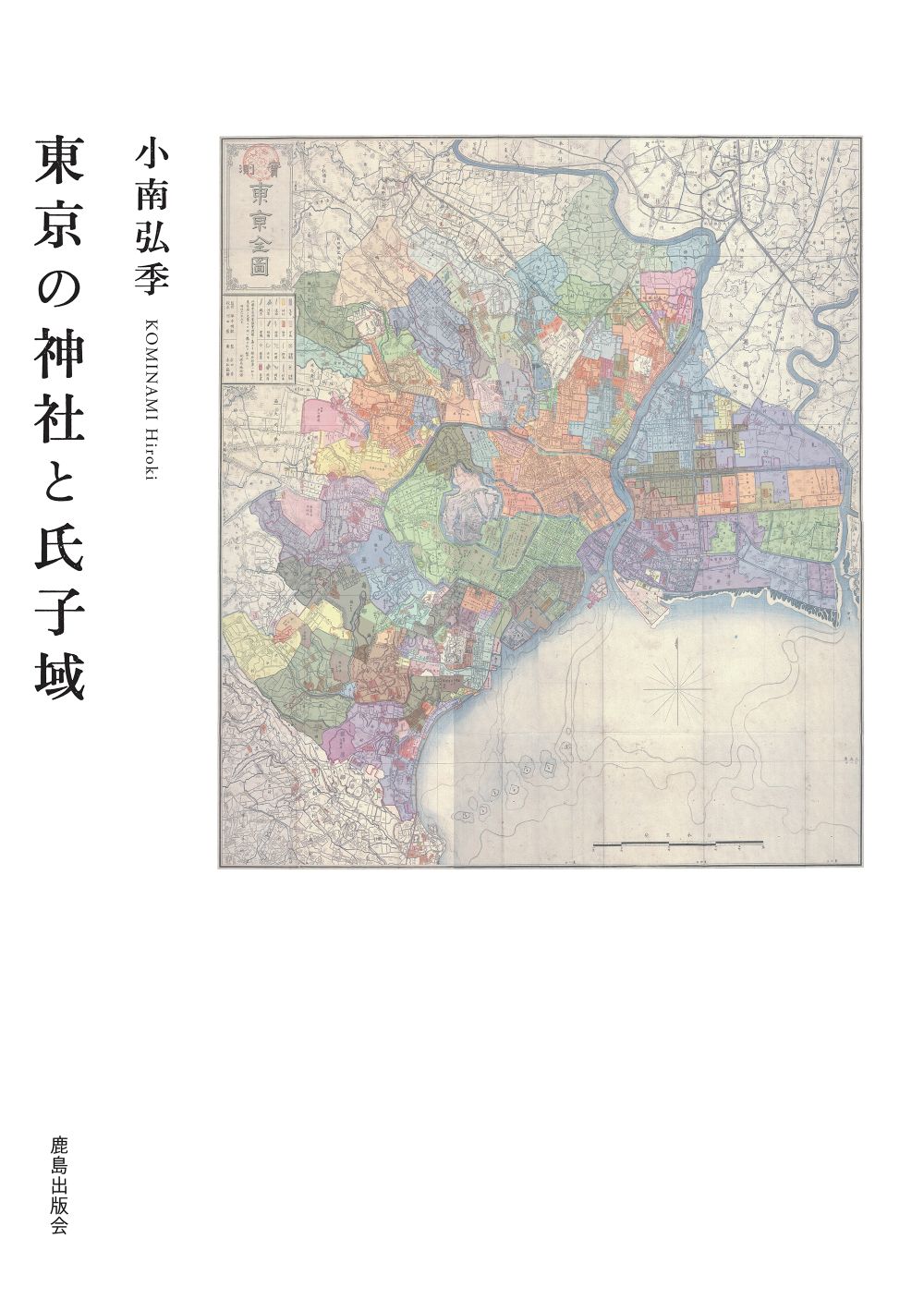
Title
Tokyo no Jinja to Ujikoiki (Shrines and Ujiko Areas in Tokyo)
Size
320 pages, A5 format
Language
Japanese
Released
March, 2026
ISBN
9784306073784
Published by
Kajima Institute Publishing Co., Ltd.
Book Info
See Book Availability at Library
Japanese Page
Shrines appear in many forms throughout the city: as small groves filled with trees, as precincts containing little more than a shrine building, or as roadside altars standing quietly at street corners. When wandering through a city, one encounters them time and again. Through rituals, New Year visits, shrine blessings for newborns, and Shichi-Go-San celebrations, shrines have remained familiar presences in the lives of many people. They have also served as places of rest, children's playgrounds, and venues for local events. Shrines are often regarded as timeless institutions that have existed unchanged since antiquity. Yet both their spatial forms and social functions have changed throughout history.
The early Meiji period witnessed sweeping reforms concerning shrines. These included the separation of Shinto and Buddhism, the restoration of the Jingikan (Department of Divinities), the introduction of the shrine-ranking system, and the incorporation of shrine priests into the state bureaucracy. The shrines we see today are fundamentally shaped by institutions and ideas established during this period. Focusing on Tokyo in the early Meiji era, this book examines how the spaces and social relationships surrounding urban shrines were reconfigured through the construction of the modern shrine system. Drawing upon primary historical sources, including official documents preserved by the Tokyo Prefectural administration and diaries kept by shrine priests, it reconstructs the changing realities of urban shrines under the emerging modern order.
The key concept in this book is the ujiko area. The term Ujiko area denotes the territory inhabited by a shrine's parishioners. Festivals were organized through the collective participation of the towns belonging to such territories, and during these festivals portable shrines, or mikoshi, circulated throughout them. The ujiko areas seen today were largely formed in the early Meiji period as part of an administrative system that complemented the newly established household registration regime. Through an examination of fundamental historical records, this study presents the first comprehensive reconstruction of ujiko areas across the entirety of Meiji-era Tokyo and demonstrates their formation through their relationship to the distribution of parishioner communities in the early modern period. By comprehensively analyzing the reorganization of priestly institutions, the administration of unranked shrines, the abolition of small roadside shrines, and transformations in shrine precincts and architecture, this book reveals the actual conditions of Tokyo's small-scale shrines in the early modern era. It further argues that ujiko area functioned as a foundational element of the modern shrine system.
Despite their ubiquity, small-scale shrines have received far less scholarly attention than large and famous shrines, leaving their overall historical significance insufficiently understood. To address this gap, this book makes extensive use of administrative records concerning shrine governance to reconstruct the spatial and social relationships of shrine networks dispersed throughout Tokyo Prefecture. By repositioning shrines not merely as religious institutions but also as institutional and spatial entities involved in urban governance and local territorial organization, the book offers a new perspective on the study of modern urban history. By looking anew at the shrines in the city, readers may discover previously unnoticed connections among local communities and gain a deeper understanding of the historical formation of urban space.
(Written by: KOMINAMI Hiroki / September 25, 2026)
Related Info
The 6th UTokyo Jiritsu Award for Early Career Academics (The University of Tokyo, 2025)
https://www.u-tokyo.ac.jp/ja/research/systems-data/n03_kankojosei.html