


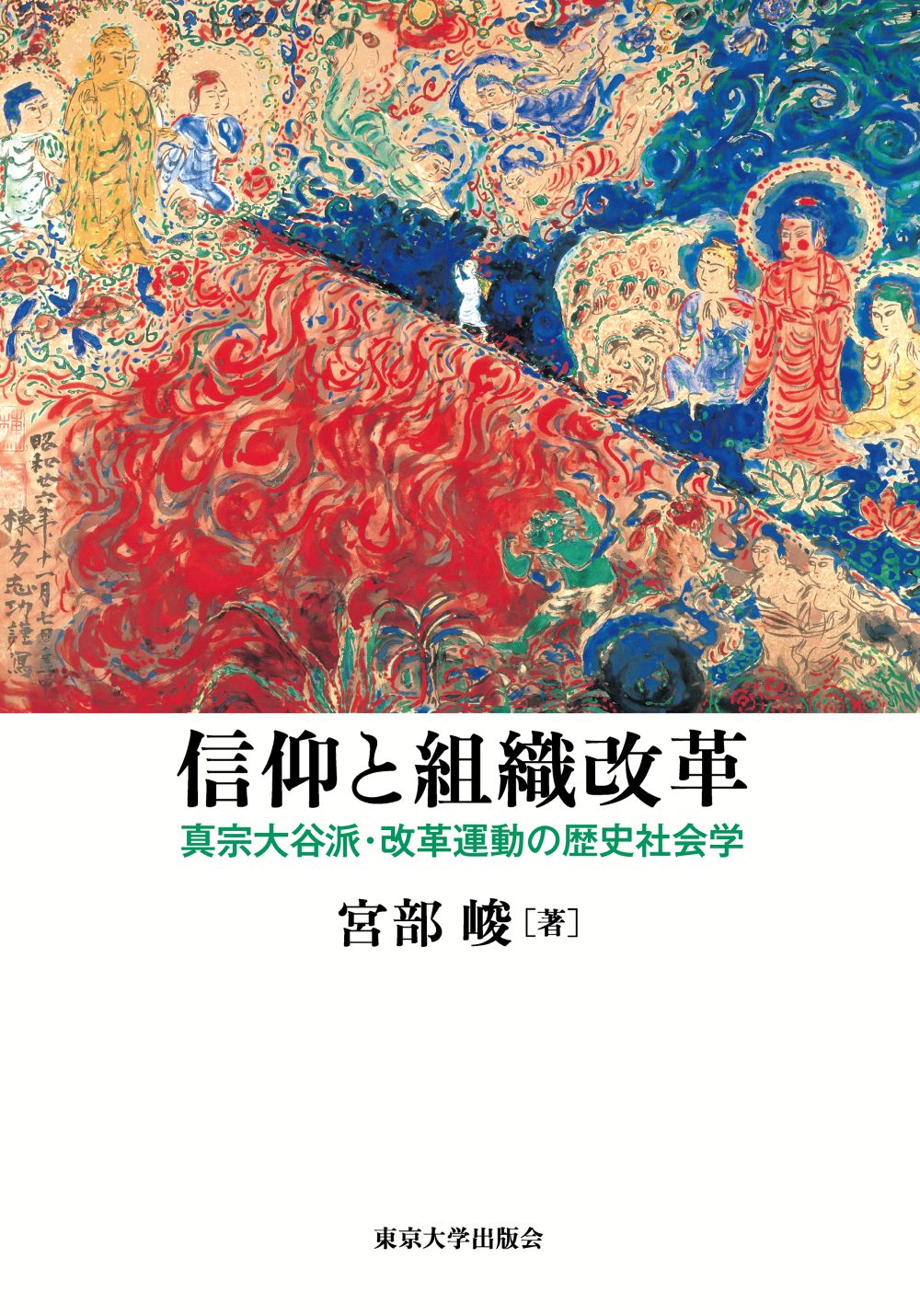
Title
Shinko to Soshiki Kaikaku (Faith and Organization Reformation - Historical Sociology of Modern Jōdo Shin Thought)
Size
258 pages, A5 format
Language
Japanese
Released
April 08, 2026
ISBN
978-4-13-016057-5
Published by
University of Tokyo Press
Book Info
See Book Availability at Library
Japanese Page
 eBook
Shinshu Otani-ha is a sect of Jodo Shinshu founded by Shinran and is one of the largest Buddhist denominations in Japan.
Anyone interested in Japanese history is familiar with Shinran and Jodo Shinshu. However, far fewer people are familiar with the modern history of Jodo Shinshu. One reason for this is the limited opportunity to learn about or even hear of this history.
In the modern era, Shinshu Otani-ha developed movements centered on both faith and organizational reform. These movements encompassed various initiatives. In terms of the faith movement, the goal was to pursue a form of faith appropriate to modern society. On the other hand, in terms of organizational reform, the objectives included introducing democratic decision-making mechanisms, improving management efficiency, and revising doctrinal systems. However, the reformers faced a major challenge: how to reconcile the denomination as a faith community with the denomination as an administrative organization.
For example, consider a religious organization that implements media strategies to attract more followers. Management strategies are important for disseminating the teachings. However, if the organization places excessive emphasis on management while neglecting the teachings, it may be criticized for degenerating into a mere business enterprise. Historically, many religious organizations have faced such criticism. The contradictions and conflicts that emerge between faith and organizational reform are unique to religious organizations.
The reform movement within Shinshu Otani-ha unfolded while grappling with these contradictions and conflicts between faith and organizational reform. A closer look at history reveals that the reformers faced numerous crises, including responses to Marxist critiques of religion, adaptation to the total war system, the rise of new religions, and conflicts with the group that valued traditional doctrines and organizational structures. It is because these crises were overcome that Shinshu Otani-ha continues to exist today.
The approach adopted in this book is grounded in historical sociology. Although there are many sociological studies of new religions that expanded their influence after World War II, as well as studies of spirituality, research on traditional Japanese Buddhism is limited. Classical sociological theory assumes that traditional religions would eventually disappear or lose their social influence. However, many traditional religious organizations, including Shinshu Otani-ha, continue to exist today. The question of how traditional religions have adapted to modern society invites a reexamination of the theoretical premises of the sociology of religion. The reform movements of Shinshu Otani-ha demonstrate how traditional religions have transformed while confronting diverse social logics.
(Written by: MIYABE Takashi / October 23, 2026)
Related Info
The 6th UTokyo Jiritsu Award for Early Career Academics (The University of Tokyo, 2025)
https://www.u-tokyo.ac.jp/ja/research/systems-data/n03_kankojosei.html