


Title
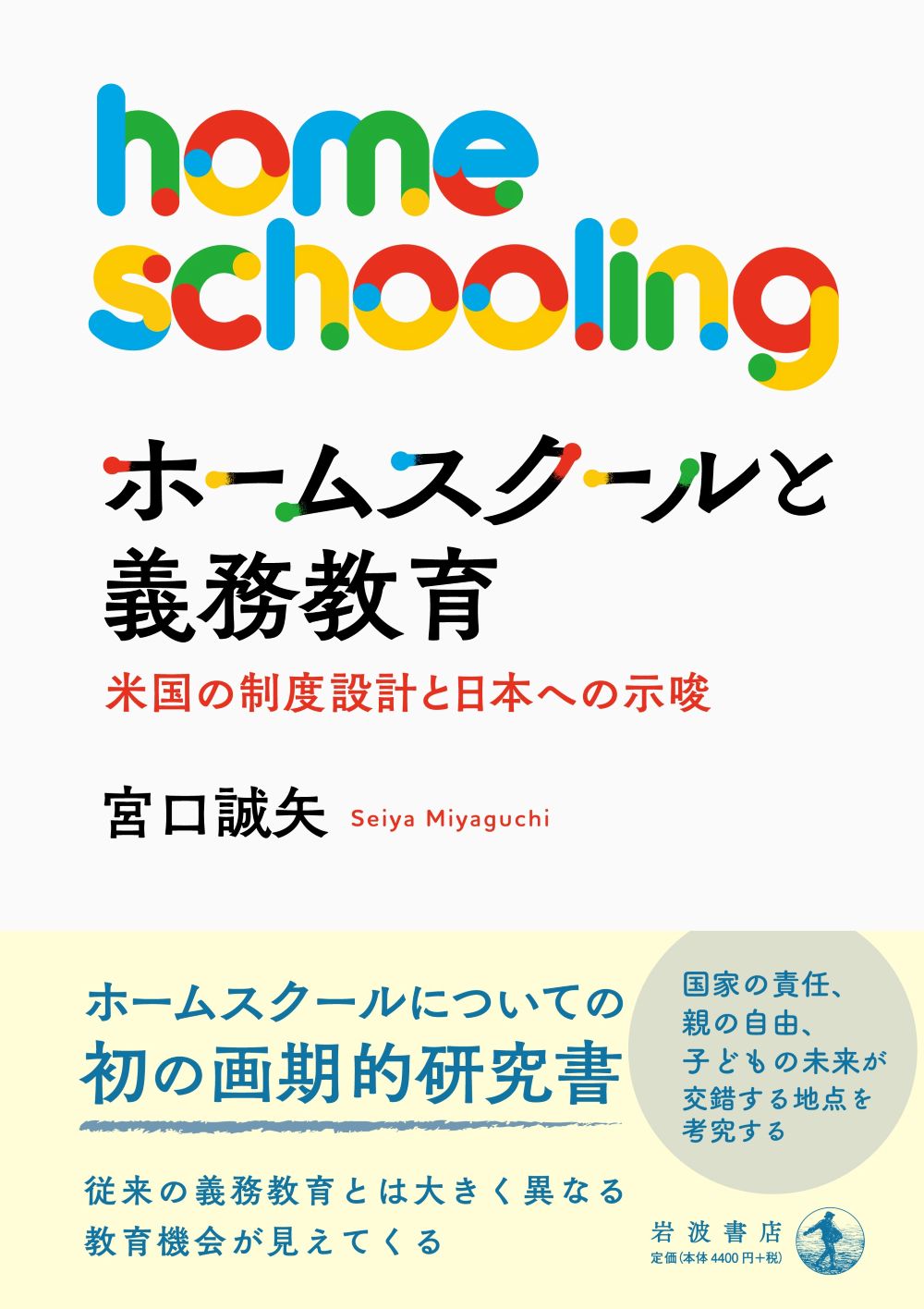
Homeschool to Gimu-kyoiku (Homeschooling and Compulsory Education - Policies and Debates in the United States and Their Implications for Japan)
Size
254 pages, A5 format, hardcover
Language
Japanese
Released
February 18, 2026
ISBN
9784000617420
Published by
Iwanami Shoten
Book Info
See Book Availability at Library
Japanese Page
 eBook
eBook
What does a country owe children who cannot—or do not—attend school?
In Japan, compulsory education has long meant school attendance. Parents are legally required to send their children, from ages six to fifteen, to school. Homeschooling, in which parents take primary responsibility for their child's formal education, therefore has no legal status. Yet more than 300,000 elementary and junior high school students in Japan can no longer bring themselves to go to school, and the number keeps rising. For at least some of these children, homeschooling could be a meaningful option.
Simply legalizing it, however, would not by itself solve the problem. Families without sufficient resources might struggle to teach effectively, and some children could reach adulthood without even basic literacy. Should homeschooling be banned, then? That conclusion is premature: how much education can be ensured depends on how the system is designed.
So what system designs are possible, and what are the strengths and weaknesses of each? The United States offers revealing cases. All fifty states permit homeschooling under widely varying rules. Policy arguments also vary significantly, ranging from defenses of entirely unregulated regimes grounded in parental rights to proposals for a presumptive ban grounded in children's rights. Yet no previous study, in Japan or elsewhere, had analyzed this wide range of policies and arguments in terms of what policy options could be introduced and how they should be evaluated. This book fills that gap, laying out the range of possible policies and distilling concepts useful for evaluating them.
The analysis also overturns a common assumption. In Japan, the United States is widely believed to regulate homeschooling effectively; in reality, most states impose no effective oversight, so educational neglect can go unnoticed by anyone outside the family. But much the same is true of Japan. When a child in Japan stops attending school, there is no mechanism for verifying what, if anything, the child is learning. Penalties for non-attendance are almost never enforced. The parents' obligation simply expires when the child turns fifteen. In effect, Japan already permits unregulated, unsupported homeschooling. The very harms people fear from legalizing homeschooling can already occur under Japan's current system—a fact that has gone largely unrecognized.
The book's scholarly contributions reach beyond homeschooling research. It draws two concepts from U.S. homeschooling policies and debates: adequacy (education meeting a defined threshold) and progress (continuous, verifiable academic advancement). By combining these two concepts in a policy framework, the book shows that broad parental freedom and the state's guarantee of education, long assumed to be locked in a trade-off, can in fact coexist. It further argues that the two rival standards for ending compulsory education, reaching a set age and demonstrating a set level of achievement, can be joined into an "achievement-conditioned age standard." This invites education scholars to rethink basic assumptions about how compulsory education is structured. These findings widen the menu of options for the reform of compulsory education.
To think about homeschooling is to question what we take for granted about schooling, and to imagine children and parents whose circumstances differ from our own. Whether you want to re-examine the "common sense" or "basic grammar" of compulsory education, or to consider what we owe children whom schools cannot yet reach, this book offers many places to begin.
(Written by: MIYAGUCHI Seiya / October 13, 2026)
Related Info
The 6th UTokyo Jiritsu Award for Early Career Academics (The University of Tokyo, 2025)
https://www.u-tokyo.ac.jp/ja/research/systems-data/n03_kankojosei.html