


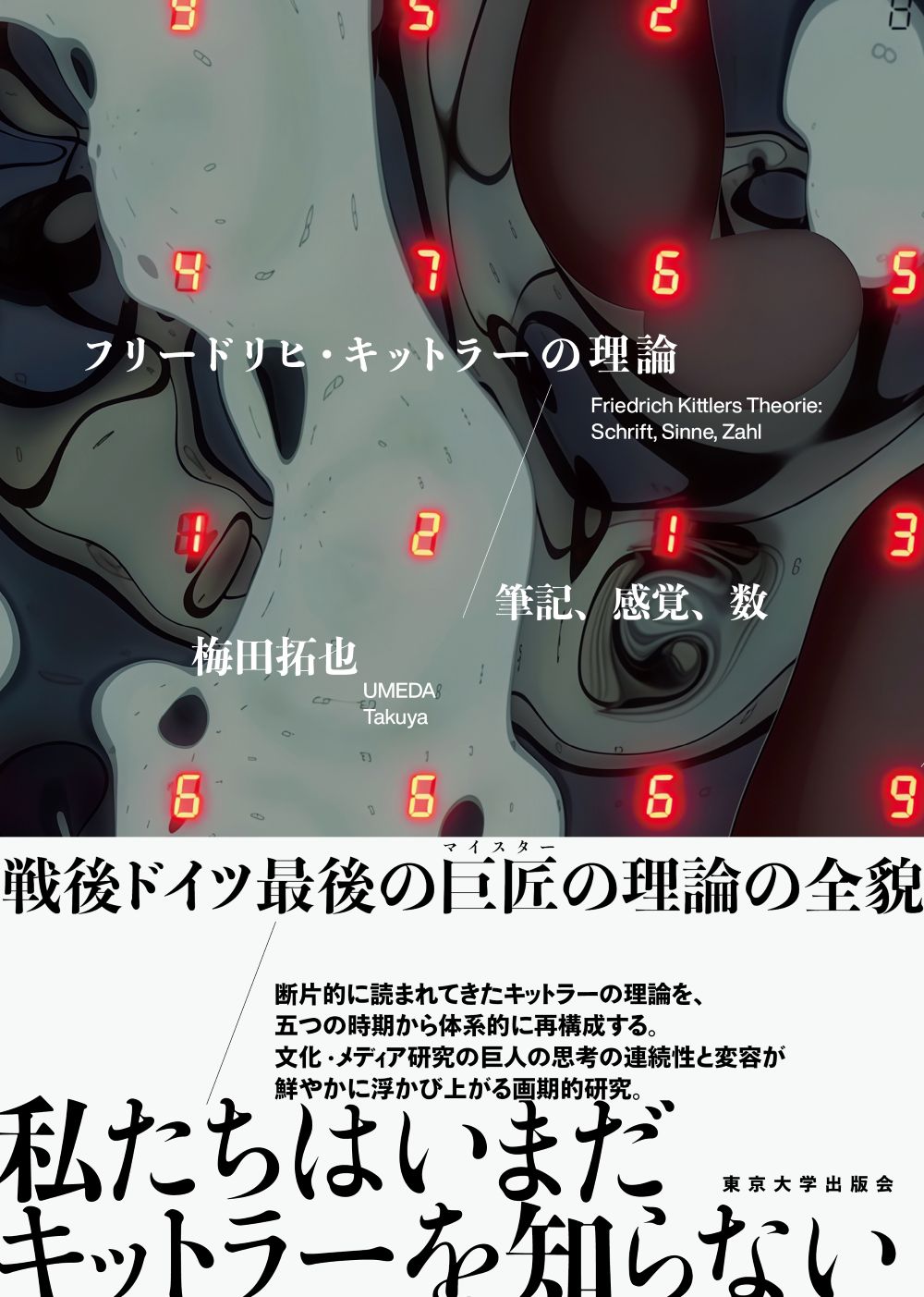
Title
Friedrich Kittler No Riron (Friedrich Kittler’s Theory - Writing, Sence, Number)
Size
360 pages, A5 format
Language
Japanese
Released
February 26, 2026
ISBN
978-4-13-016055-1
Published by
The University of Tokyo Press
Book Info
See Book Availability at Library
Japanese Page
The name Friedrich Kittler is familiar to anyone interested in media or cultural studies. His innovative works such as Aufschreibesysteme 1800・1900 and Grammophon Film Typewriter has a wide-ranging impact on contemporary humanities. However, Kittler addressed an extraordinarily broad spectrum of subjects, from ancient alphabets to modern computers, in a provocative and often opaque style laced with irony and humor, making it difficult to grasp his thoughts. Consequently, although his arguments have often been cited in a fragmentary manner for the insights they offer into specific objects of study, their overall structure and development have not been sufficiently examined.
Friedrich Kittler's Theory: Writing, Sense, Number is the first monograph in Japan devoted to Kittler’s thoughts. Drawing on close reading and comparative analyses of multiple texts, including previously unpublished materials, this study seeks to illuminate the scope of his theory. The analysis is organized into five phases: (1) German literary studies in the 1970s, (2) the transition from literary studies to media studies in the early 1980s, (3) media-historical research from the late 1980s to the early 1990s, (4) his work on computers in the 1990s, and (5) European cultural history in the 2000s. Through this framework, the book moves beyond conventional assessments that characterize his work as a form of “materialism,” emphasizing the physical and technical conditions of culture, or as “technological determinism,” which excludes cultural and social factors. Instead, it considers both continuities and transformations in his theory through the interplay of three central themes: writing, sense, and numbers.
The book also engages with the academic and social environments surrounding Kittler. In the German-speaking humanities of his time, scholars inherited traditions such as hermeneutics, critical theory, psychoanalysis, and ontology while simultaneously incorporating newer approaches, including post-structuralism, media theory, and systems theory. Simultaneously, German society was undergoing profound transformations that unsettled the conditions of knowledge: the rise and decline of the student movement, tensions of the Cold War, and spread of computer technology. By closely examining these historical contexts, this book reinterprets Kittler’s theory as something forged in response. What also emerges is one facet of contemporary German thought that has received comparatively less attention than the French theory in Japan.
The scope of Kittler’s theory extends far beyond media, encompassing literature, philosophy, religion, education, art and design, music, film, the military, and the history of science and technology. His work compels us to reconsider objects traditionally confined to individual disciplines by approaching them from the perspective of their technical conditions, thereby cutting across established boundaries. In this sense, the book not only reflects on Kittler’s achievements, but also offers a framework for thinking about today’s technological environment, particularly the impact of advances in computational technologies, including artificial intelligence, on knowledge and culture. It is hoped that this study will lay the groundwork for a historical understanding of Kittler’s theory and open a path toward the interdisciplinary humanities he envisioned.
(Written by: UMEDA Takuya / April 06, 2026)
Related Info
The 6th UTokyo Jiritsu Award for Early Career Academics (The University of Tokyo 2025)
https://www.u-tokyo.ac.jp/ja/research/systems-data/n03_kankojosei.html