


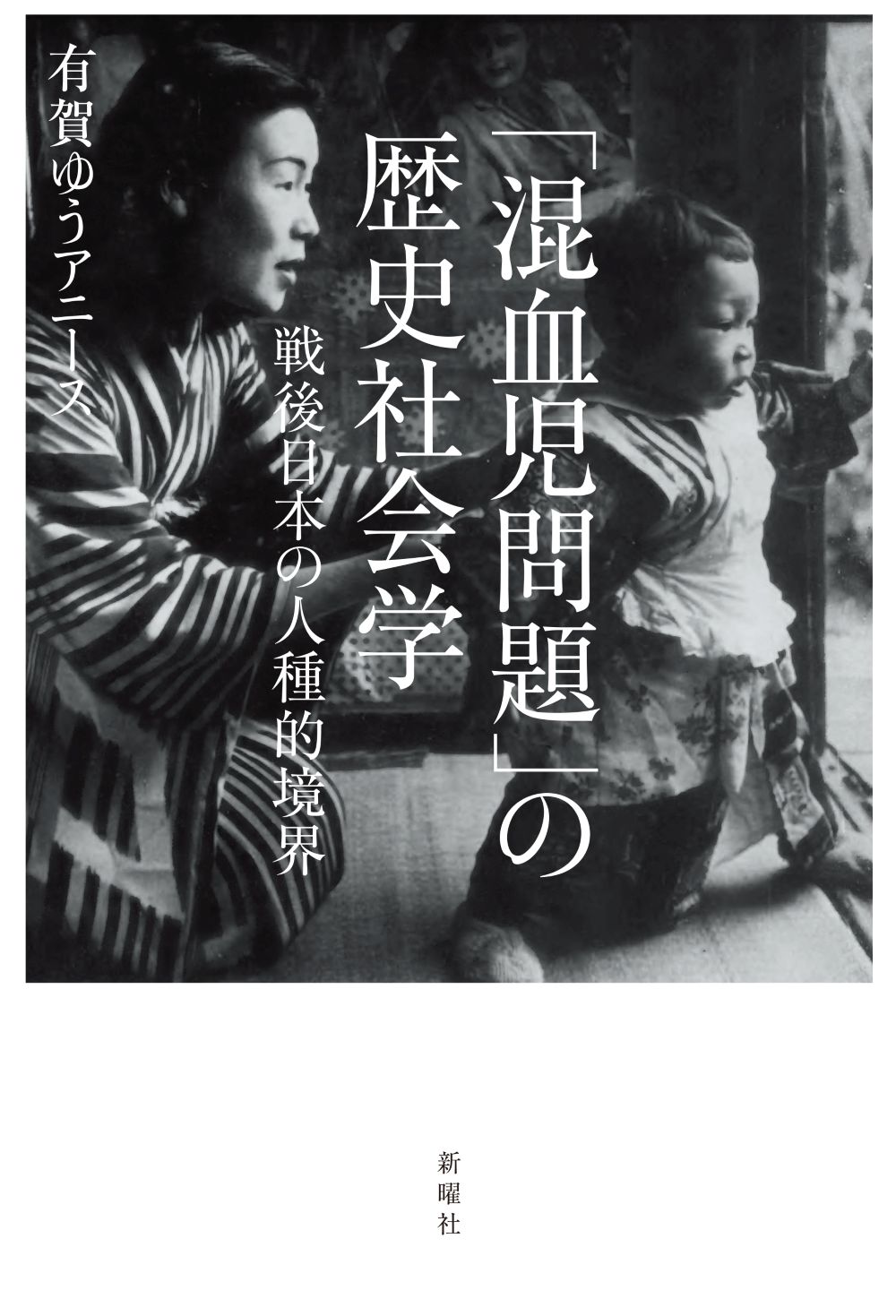
Title
“Konketsu-ji-mondai” no Rekishi-shakaigaku (Historical Sociology of “Mixed-blood Children Problem” - Racial Boundaries in Post-war Japan)
Size
344 pages, 127x188mm
Language
Japanese
Released
January 30, 2026
ISBN
9784788519084
Published by
Shinyosha
Book Info
See Book Availability at Library
Japanese Page
“Regarding the issue of ‘mixed-blood’ children... for our nation, this is a unique phenomenon of unprecedented importance in our history.” (The 15th House of Councillors Welfare Committee, February 2, 1953)
What exactly was the “mixed-blood children problem”? During the Allied Occupation of Japan following World War II, many children were born to Allied servicemen and Japanese women. Known as konketsuji (mixed-blood children), their presence and welfare became a major point of public and political contention. At least 70 years ago, certain Japanese politicians viewed this as a crisis of national significance. Yet today, when I ask students in a large lecture hall if they know of this issue or the lives of those caught within it, almost no hands go up. Why has a phenomenon once considered a national emergency, been so thoroughly consigned to oblivion? This book begins by deconstructing the mechanisms of this “forgetting.”
Through archival research both in Japan and abroad, as well as interviews with the individuals once labeled “mixed-blood children,” this book clarifies how the boundaries of “mixed-blood” and “Japanese,” were constructed. It further examines how these children were treated under the weight of those shifting boundaries.
One of the central insights offered in this work is how the boundary of “race” operates in multifaceted and cumulative ways. Immediately after the defeat, both the public and policymakers expressed anxiety over the birth of these children, leading to the formal and informal regulation of prostitution and reproduction (Chapter 1). Both the Japanese and U.S. governments officially adopted a policy of “non-discrimination and equality,” ostensibly treating these children as ordinary Japanese citizens without regard for racial difference. However, in practice, some child welfare facilities pursued “extra-legal measures” such as international adoption, tailoring their care to the perceived peculiarity of these children (Chapters 2). On one hand, these children were legally classified as “Japanese” based on their nationality, with the goal of integrating them into general schools and society. On the other hand, due to their white or black heritage, they were often viewed as racially “non-Japanese,” leading to the active promotion of overseas adoption as a way to remove them from the national body (Chapters 3). Caught in this ambiguous position as they grew into adulthood, many faced persistent exclusion and discrimination in schooling, employment, and marriage (Chapter 4).
Today, terms such as haafu (half) or mikkusu (mixed) are often used in Japan with celebratory connotations of diversity. However, behind this contemporary image, can we truly say that the racial boundaries once etched into the term konketsuji have vanished? Turning back the clock to the 1950s—the foundational era of modern Japan—is not merely an act of revisiting a past tragedy. It is a necessary interrogation of the boundaries of “Japaneseness” that we continue to draw, often unconsciously, today. If this book encourages readers to become more aware of the dynamics of inclusion and exclusion driven by race and origin, it will have achieved its purpose.
(Written by: ARUGA Yu-Anis / July 10, 2026)
Related Info
The 6th UTokyo Jiritsu Award for Early Career Academics (The University of Tokyo 2025)
https://www.u-tokyo.ac.jp/ja/research/systems-data/n03_kankojosei.html