


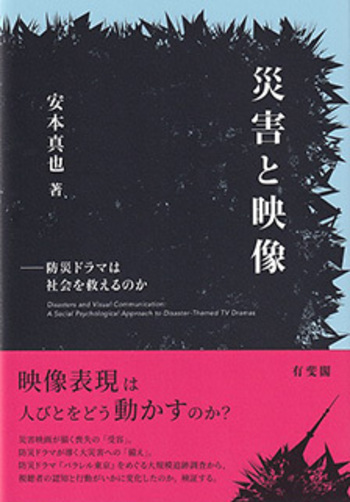
Title
Saigai to Eizou (Disasters and Visual Communication - A Social Psychological Approach to Disaster-Themed TV Dramas)
Size
324 pages, A5 format, hardcover
Language
Japanese
Released
April 03, 2026
ISBN
9784641175143
Published by
Yuhikaku Publishing Co., Ltd.
Book Info
See Book Availability at Library
Japanese Page
 eBook
eBook
Every time an earthquake strikes, calls to “prepare for disasters” appear on television screens and in newspapers. However, in practice, preparedness rarely advances to the extent we might expect. What, then, actually moves people to act? This book examines that question through the lens of visual media.
The book is organized into two main parts. The first traces changes in socially shared images of disaster in Japan through an analysis of disaster films produced in the country. It asks what kinds of disasters have tended to become the subjects of films and how the narrative focus has shifted among the pre-disaster, trans-disaster, and post-disaster phases. In particular, the book shows that recent works have come to place less emphasis on the trans-disaster phase—the scenes of destruction and crisis during the disaster itself—and more on the post-disaster phase, depicting people who, while carrying a sense of loss, strive to recover and move toward restoration and reconstruction. This shift may suggest that disasters have become harder to consume simply as cinematic spectacle and that Japanese society has increasingly come to regard disaster as something with which it must live. By tracing these changes in film, the book reveals shifts in how Japanese society has imagined, received, and made sense of disaster.
Against this broader social background, the second half examines the effects of Parallel Tokyo, an NHK television drama produced around the theme of disaster preparedness. The study followed the same participants at three time points: immediately before the broadcast, immediately after it, and three months later. In doing so, it examined the effects of viewing the program. Based on the national government’s damage estimates for The Tokyo Metropolitan Earthquake, the drama enabled viewers to imagine, in concrete terms, a disaster they had not yet experienced. It was also a significant object of analysis because it was delivered through television broadcasting, placed at the center of a week-long disaster-preparedness campaign, and presented in the narrative form of a drama.
The analysis proceeds from three perspectives: knowledge, cognition, and behavior. What the findings make clear is a simple point: people become more engaged with disaster preparedness when visual media moves them emotionally, and the primary emotion involved is fear. Among the various risks depicted in the program, those that viewers perceived as relatively more frightening came to be seen as risks that could affect them personally. Simultaneously, the study also shows that even when disaster-preparedness messages are conveyed through such programs, they do not easily lead to behavioral change. Even so, television continues to exert broad influence at the cognitive level. For that reason, from the perspective of disaster preparedness, its influence needs to be used effectively. Doing so requires sustained research into how the effects of visual media can be maximized. Precisely because disaster-preparedness communication is a complex challenge, it must be addressed as a serious subject of research. As a first step in that direction, this book presents the possibilities of mass media and visual expression and offers a hopeful account of what they may still be able to do.
(Written by: YASUMOTO Shinya / October 16, 2026)
Related Info
The 6th UTokyo Jiritsu Award for Early Career Academics (The University of Tokyo, 2025)
https://www.u-tokyo.ac.jp/ja/research/systems-data/n03_kankojosei.html