


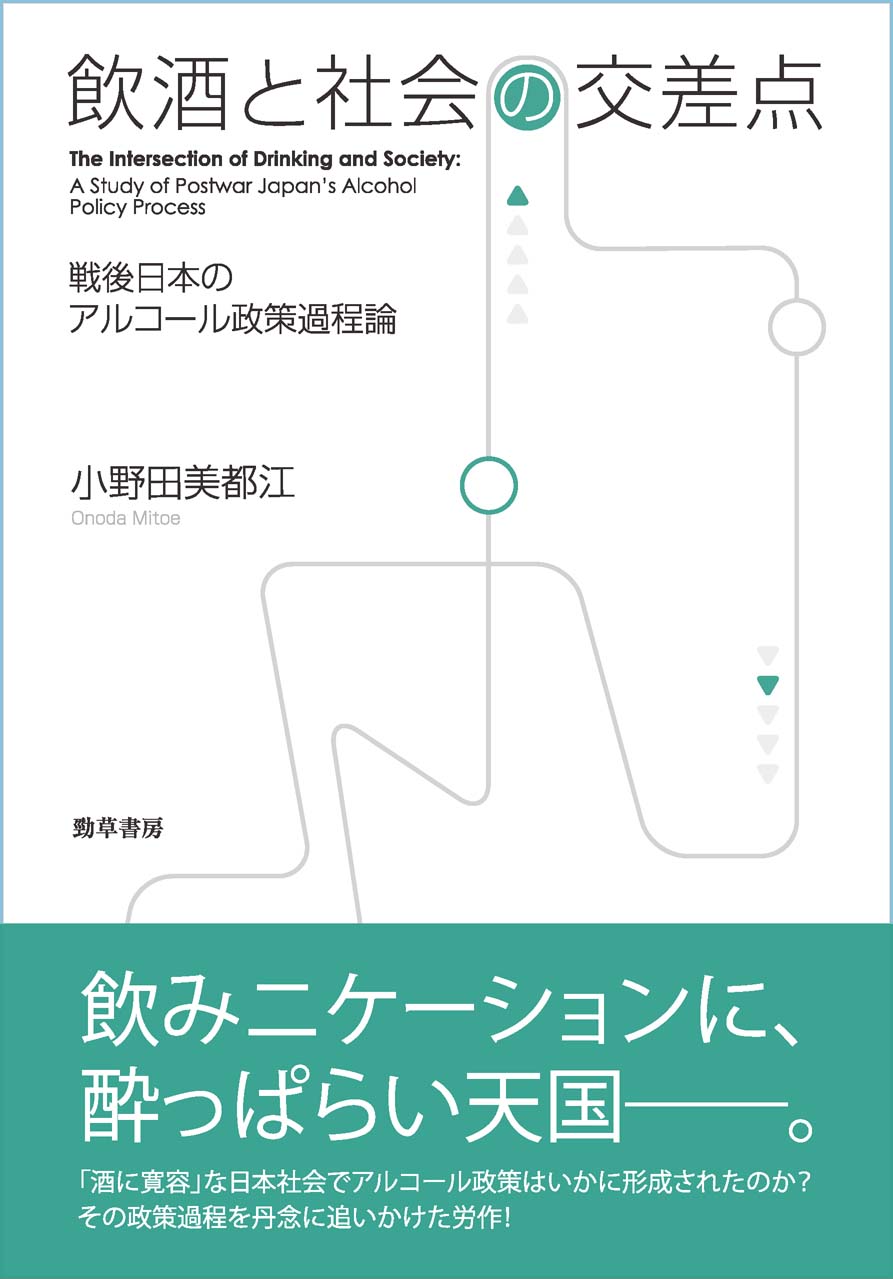
Title
Inshu to Shakai no Kosaten (The Intersection of Drinking and Society - A Study of Postwar Japan’s Alcohol Policy Process)
Size
352 pages, A5 format
Language
Japanese
Released
January, 2026
ISBN
978-4-326-30355-7
Published by
Keiso Shobo
Book Info
See Book Availability at Library
Japanese Page
 eBook
eBook
There are cases in which our everyday behavior is not left entirely to individual discretion but is regulated by laws and ordinances, such as the rule that alcohol and tobacco are for those aged 20 and over, or the guideline of maintaining smartphone use within approximately two hours per day. This book explores the following question: What processes lead to the establishment of laws encroaching on personal privacy? Focusing on the period of 80 years following World War II, this study examines the laws that regulate drinking (alcohol policy) and analyzes their policy processes.
Alcohol is an intoxicating beverage that possesses addictive properties. This leads to social problems such as drunk driving and other violent incidents committed under influence. Inappropriate drinking can also lead to health problems. However, alcohol has fostered rich culture and traditions, adding enjoyment to everyday life. It can also function as a social lubricant by creating relaxed settings where people can confide in each other. Given the dual nature of alcohol, both its benefits and risks, this book highlights the processes through which laws regulating alcohol-related problems are enacted.
This study focuses on three major postwar Japanese laws whose primary purpose was to regulate drinking: the Act on Prevention of Public Nuisance Caused by Inebriated Persons (enacted in 1961), revisions in 2000 and 2001 to the Minor Drinking Prohibition Act (now the Act Prohibiting Drinking by Persons Under 20 Years of Age), and the Basic Act on Measures against Alcohol-related Health Harm (enacted in 2013). For analysis, the book employs Kingdon’s “Multiple Streams Framework.” This framework holds that the coupling of the three streams―the problem stream, the policy stream, and the political stream―opens a “policy window”, through which a policy issue enters the decision agenda. It has been used worldwide across many research fields to analyze policy processes. By applying this framework, it is possible to compare alcohol policies across different historical periods within Japan, as well as to identify similarities and differences between Japan’s alcohol policies and those of other countries. Furthermore, since the “policy window model” explains the "pre-decision making process" of policy-making, it can reveal who was involved and what movements occurred in the pre-decision stage when regulating drinking, an activity involving many people.
All laws covered in this book are member-initiated legislation in which lawmakers draft bills and submit them to the Diet. From the perspective of member-initiated legislation, “citizen-led and bipartisan” bills face the challenge of policy community homogeneity. Gathering individuals with similar values creates a situation where diverse opinions are unlikely to be reflected. For instance, in the case of “competition-regulating” members’ bills, priority tends to be given to the interests of supporting organizations and the industry, and the policy process becomes a black box.
No previous research has examined the policy process for alcohol-related issues over a long period using policy process models. How can we ensure that the cultivation of Japan’s alcohol-related culture and traditions coexists with responsible drinking practices? This book argues that when enacting laws that step into people’s private spheres, it is crucial to remain conscious of where the boundary of the public sphere lies and to secure fair and open dialogue.
(Written by: ONODA Mitoe / August 14, 2026)
Related Info
The 6th UTokyo Jiritsu Award for Early Career Academics (The University of Tokyo, 2025)
https://www.u-tokyo.ac.jp/ja/research/systems-data/n03_kankojosei.html