

 Find a book


Title
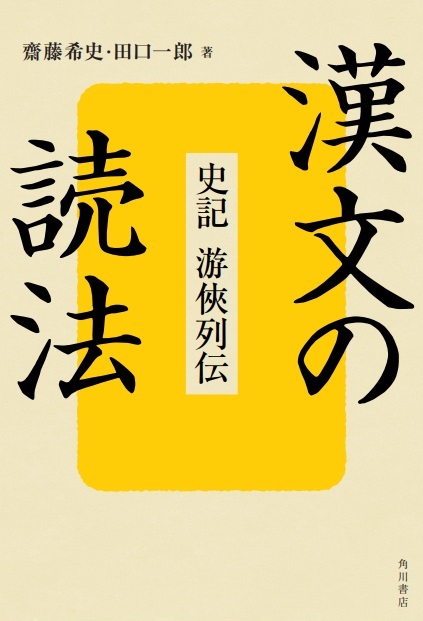
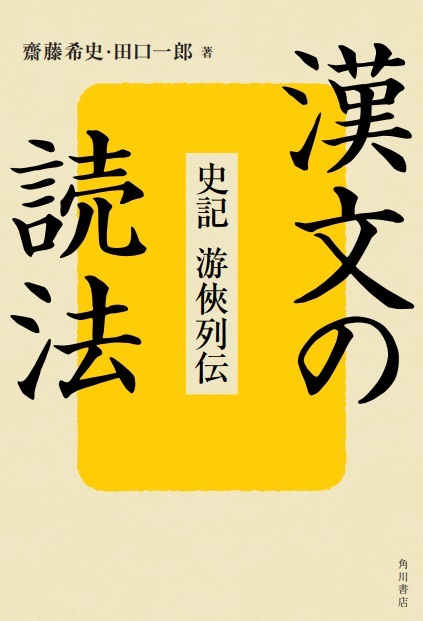
Kanbun no Dokuhou (How to Read Classical Chinese - The Biographies of Wandering Cavaliers)
Size
240 pages, 127x188mm
Language
Japanese
Released
March 29, 2024
ISBN
9784044007881
Published by
KADOKAWA
Book Info
See Book Availability at Library
Japanese Page
Kanbun no Dokuhou: Shiji Yūkyō Retsuden (KADOKAWA, 2024), which I co-authored with Professor Taguchi Ichirō, has already been introduced on BiblioPlaza by my co-author and generously reviewed by Professor Yada Tsutomu in Kyōyō Gakubu Hō. Let me, then, write about something else.
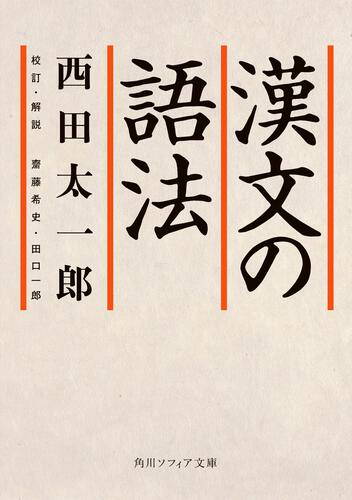
In 2023, Professor Taguchi and I prepared a corrected reissue of Nishida Taichirō's Kanbun no Gohō for the Kadokawa Sophia Bunko paperback series. There are, it turns out, more readers of kanbun (classical Chinese as read and written in Japan) than one might expect, and the book has gone through several printings. Encouraged, we began to talk about a companion volume for reading practice. But practice on what? The Shiji, we both said—obviously, the Shiji. Reading the whole was out of the question, so Professor Taguchi proposed the "Biographies of the Wandering Knights" (Ch. Youxia liezhuan; Jp. Yūkyō retsuden), a chapter that reads well, is short enough to read in its entirety, and whose prefatory essay is justly admired. The youxia themselves, too, are worth knowing if one is to understand China. So a book on the "Biographies of the Wandering Knights" it would be.
In the humanities, a "co-authored" book is usually a product of divided labor: one rarely knows what the other contributors have written until the volume appears. Ours was different. Both of us worked on the same text throughout, revising each other's translations and explanations freely — genuinely collaborative writing. Email would never have sufficed. So we set up a repository on GitHub with kanbun markup text, opened issues, argued the points there, and rewrote in place. Pulling, pushing, the occasional merge: cumbersome at first, but once we got used to it, oddly reassuring.
Something of that atmosphere we hoped would carry into the book, and so between sections of the commentary we inserted "Columns" and a feature called Kanbun Dangi ("Conversations on Kanbun") — exchanges of the kind we used to have as graduate students and still have in the lab today, on alternative readings, dictionaries, and so on. These are exchanges of the kind we used to have as graduate students and still have in our department today, on alternative readings, dictionaries, and so on. With comparisons to the Hanshu version of the same biographies, the book might also serve as preparation for more specialized course.
Neither of us is a historian of the Han or a specialist in Old Chinese. We simply read the Shiji as scholars of Chinese literature ordinarily do — but what that "ordinarily" consists of is often half unconscious. In this book we tried to put it into words, to explain, at the risk of saying too much, why we read this character one way and not another. Books of this kind are uncommon in kanbun; one falls easily into "read it this way because that is how it reads — and read more." That we resisted the reflex was, I suspect, thanks to the collaboration: if an explanation was thin, the other party said so without ceremony.
Preparing the book gave us occasion to take down once again the Chinese grammars we had bought as graduate students and leaf through them — a return to the pleasures of standing in the doorway of our discipline. We hope a little of that comes across to our readers.
(Written by SAITO Mareshi, Professor, Graduate School of Humanities and Sociology / 2026)