

 Find a book


Title
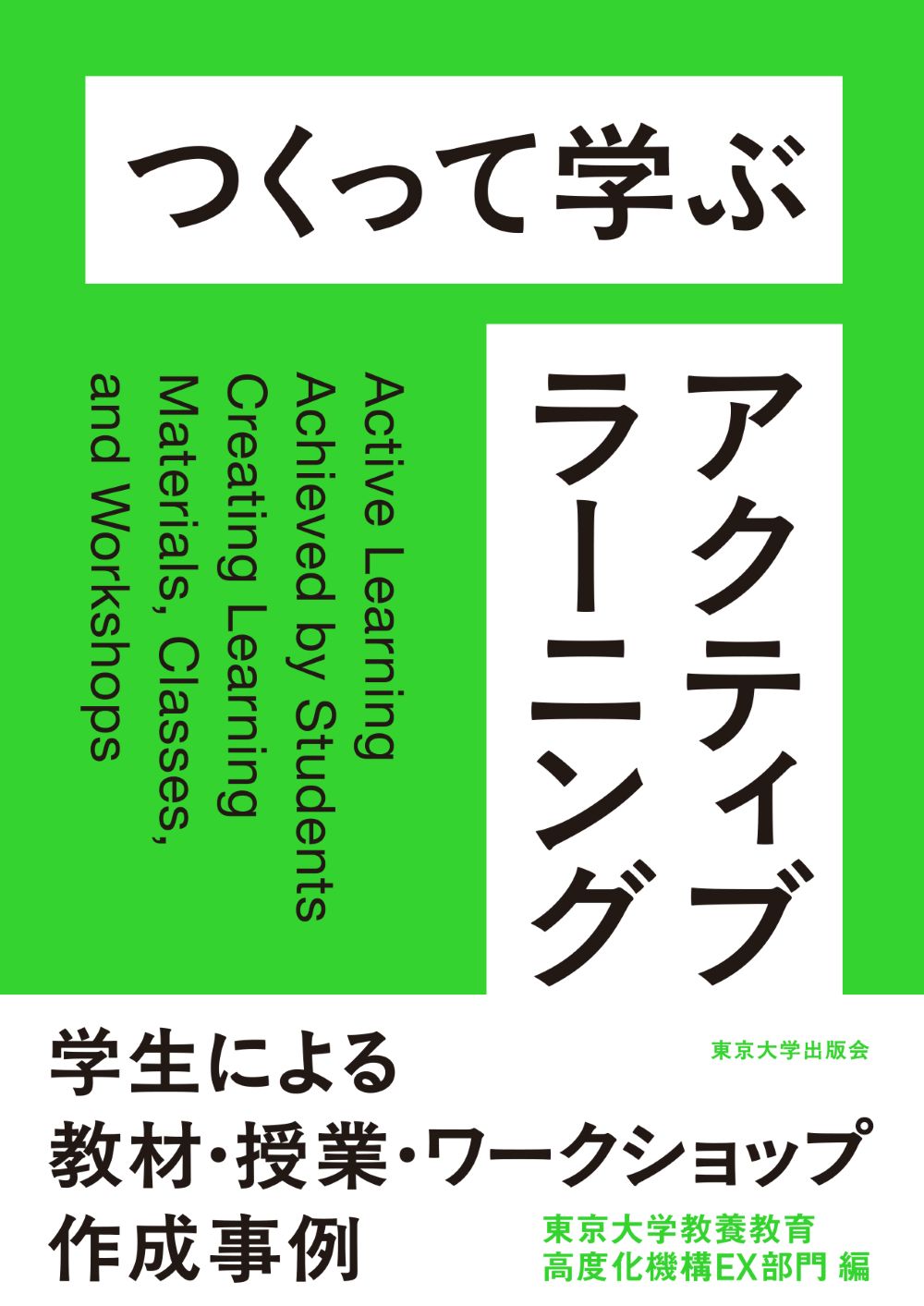
Tsukutte-Manabu Active Learning (Active Learning Achieved by Students Creating Learning Materials, Classes, and Workshops)
Size
168 pages, A5 format
Language
Japanese
Released
March 03, 2025
ISBN
978-4-13-053201-3
Published by
University of Tokyo Press
Book Info
See Book Availability at Library
Japanese Page
Have you ever engaged in "making something" activities in a course? This book focuses on courses that incorporate "making something" as a learning activity. In particular, the book introduces courses where students engage their minds while "making something" to deepen their understanding of the learning content. These are not courses where "making something" is the ultimate goal, but rather courses that adopt "making something" as a method to achieve learning goals.
The University of Tokyo has been implementing active learning initiatives for nearly 20 years. Active learning often involves discussions, presentations, role-playing, and other activities. Each method is selected to achieve the course's learning goals. This book presents the process of achieving learning goals through the act of "making something." For students, this book can help you understand the purpose behind the design of courses you've taken, and provide guidance when you need to develop educational or learning programs yourself.
This book consists of two parts: "Part 1: Theory" and "Part 2: Case Studies." Chapter 1, "Designing Active Learning Through Making Something" (Part 1: Theory), describes the background for why active learning is necessary and the educational theories and methods related to "learning through making something." It also explains the characteristics and structural framework of "learning through making something" to help readers understand the case studies in Part 2. Reading Chapter 1 before examining the case studies in Part 2 will facilitate a deeper understanding of the distinctive features and innovations of each case.
"Part 2: Case Studies" introduces examples of "creating learning materials" (Chapters 2-6), "creating classes" (Chapters 7-8), and "creating workshops" (Chapter 9). Each case study describes what students created, for whom, and for what purpose, how they created it, and the effects and benefits of "learning through making something". Some courses have students work individually while others involve group work; some produce digital outcomes while others create paper-based materials, and some have no fixed form. The detailed descriptions of these varied cases make for enjoyable comparative reading.
Furthermore, Chapter 10 in "Part 2: Case Studies," titled "Roundtable Discussion: Design Principles for 'Learning Through Making Something for Active Learning,'" features the case study authors candidly discussing not only the benefits of "learning through making something" but also their concerns and challenges. The problems and challenges raised here are common not just to "learning through making something" but to active learning in general. You can learn about aspects of teaching that are usually invisible—what difficulties instructors face when conducting classes and how they handle them. "Learning through making something" is just one approach to active learning. However, the characteristics, benefits, concerns, and challenges revealed through these case studies can serve as reference points for conducting any course. We hope that not only education professionals but also students will read this book and join us in thinking about "what kinds of courses enable better learning."
(Written by NAKAZAWA Akiko, Project Associate Professor, Graduate School of Arts and Sciences / 2025)