



Inaugural Meeting of the iPREP-Flavivirus Initiative Toward an International Research Framework for Infectious Disease Preparedness

The inaugural meeting of the iPREP-Flavivirus Initiative (Immunology for Pandemic Readiness and Evaluation Platform), a new international framework for flavivirus research, was held on January 20, 2026.
The consortium is based on a concept proposed by Professor Meng Ling Moi (Department of International Health, Graduate School of Medicine, The University of Tokyo) and was planned upon accumulated achievements in flavivirus research—such as dengue and Zika virus studies—developed under public research support programs including AMED.
The meeting brought together a total of 102 researchers from 48 institutions, including national research institutes, universities, and medical institutions across 15 countries and regions, spanning Asia, Oceania, the Middle East, Europe, and North America.
While focusing on flavivirus research, the initiative aims to enhance cross-regional collaboration and research infrastructure. Through this approach, it seeks to combine leadership in infectious disease research with the potential to extend research outcomes across a broad range of related fields. By emphasizing strong international partnerships, the consortium aims to contribute to research foundations relevant to future infectious disease preparedness.
During the meeting, participants shared past research achievements and the overall concept of the initiative and discussed the current status and challenges of flavivirus research in different regions. Differences in research resources across regions, together with exchanges on experimental approaches and technical collaboration, were highlighted as key strengths of the consortium, while approaches to addressing existing gaps through synergistic collaboration were also discussed.
Discussions were conducted from interdisciplinary and international perspectives, with a focus on the development of research infrastructure to support preparedness for future public health challenges.
By establishing a collaborative framework that does not depend on a single research question or institution, the consortium represents a solid first step toward sustained international cooperation.
Moving forward, the initiative will continue to deepen collaboration between the University of Tokyo and international partners, leveraging research support programs such as AMED to promote the development of a continuous and evolving international research infrastructure for infectious disease research and preparedness.

Snapshot from the iPREP-Flavivirus international meeting (January 20, 2026).
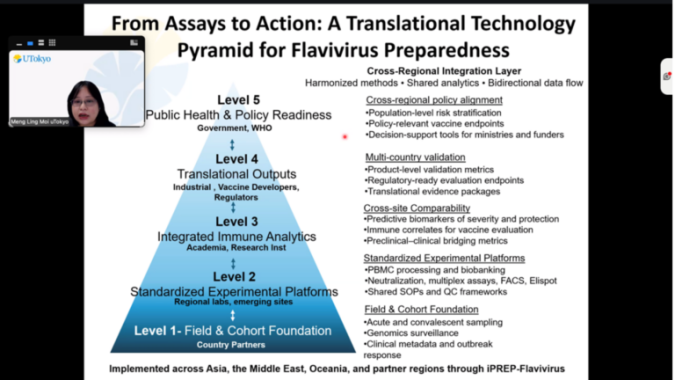
Conceptual framework for translational flavivirus preparedness.
The consortium is based on a concept proposed by Professor Meng Ling Moi (Department of International Health, Graduate School of Medicine, The University of Tokyo) and was planned upon accumulated achievements in flavivirus research—such as dengue and Zika virus studies—developed under public research support programs including AMED.
The meeting brought together a total of 102 researchers from 48 institutions, including national research institutes, universities, and medical institutions across 15 countries and regions, spanning Asia, Oceania, the Middle East, Europe, and North America.
While focusing on flavivirus research, the initiative aims to enhance cross-regional collaboration and research infrastructure. Through this approach, it seeks to combine leadership in infectious disease research with the potential to extend research outcomes across a broad range of related fields. By emphasizing strong international partnerships, the consortium aims to contribute to research foundations relevant to future infectious disease preparedness.
During the meeting, participants shared past research achievements and the overall concept of the initiative and discussed the current status and challenges of flavivirus research in different regions. Differences in research resources across regions, together with exchanges on experimental approaches and technical collaboration, were highlighted as key strengths of the consortium, while approaches to addressing existing gaps through synergistic collaboration were also discussed.
Discussions were conducted from interdisciplinary and international perspectives, with a focus on the development of research infrastructure to support preparedness for future public health challenges.
By establishing a collaborative framework that does not depend on a single research question or institution, the consortium represents a solid first step toward sustained international cooperation.
Moving forward, the initiative will continue to deepen collaboration between the University of Tokyo and international partners, leveraging research support programs such as AMED to promote the development of a continuous and evolving international research infrastructure for infectious disease research and preparedness.
Snapshot from the iPREP-Flavivirus international meeting (January 20, 2026).
Conceptual framework for translational flavivirus preparedness.