



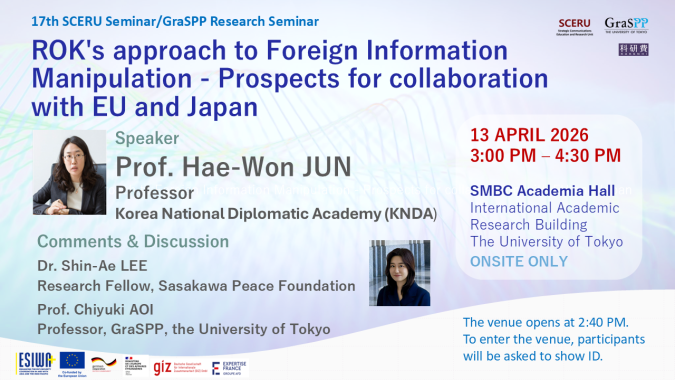
ROK's approach to Foreign Information Manipulation - Prospects for collaboration with EU and Japan
Details
| Type | Lecture |
|---|---|
| Intended for | General public / Enrolled students / International students / Alumni / Companies / University students / Academic and Administrative Staff |
| Date(s) | April 13, 2026 15:00 — 16:30 |
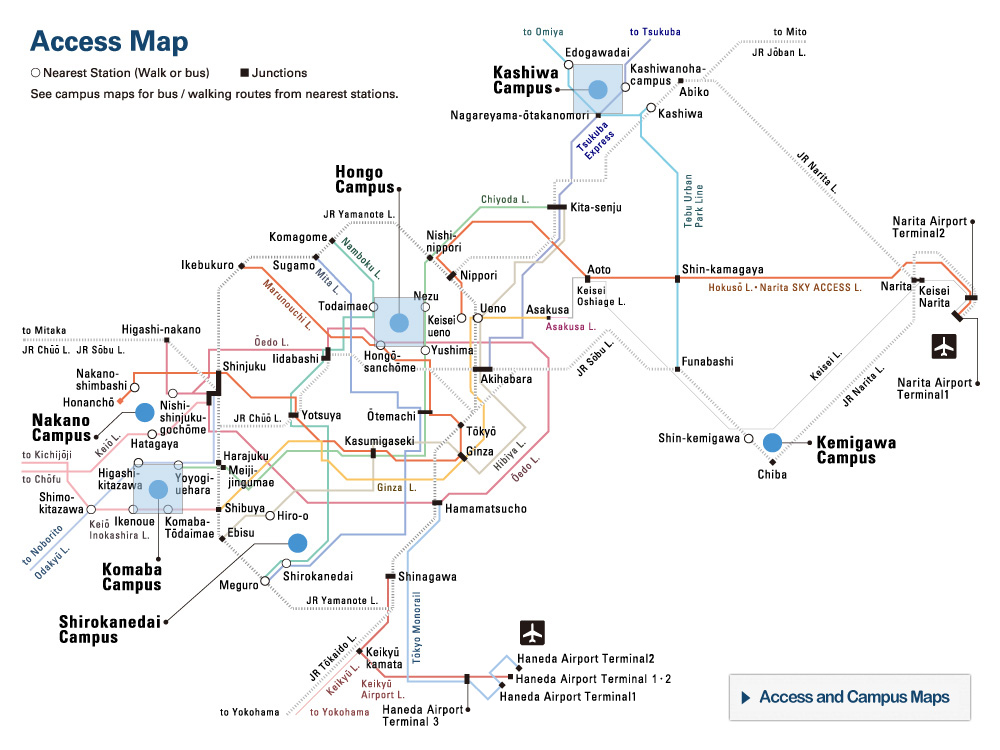
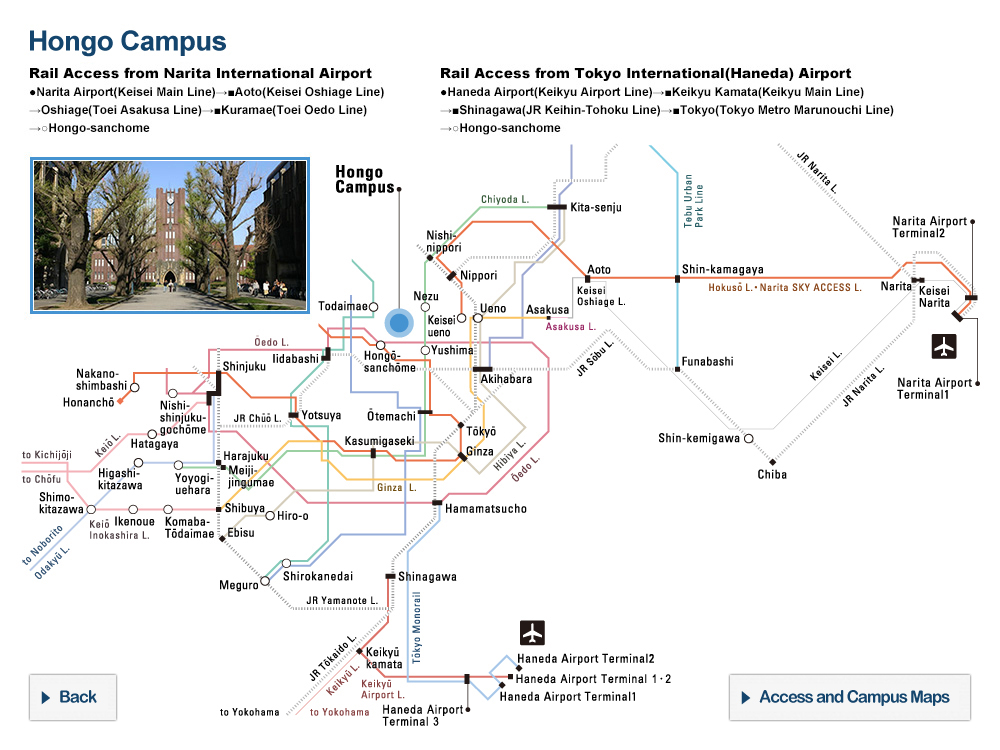
| Location | Hongo Area Campus |
| Venue | SMBC Academia Hall 4th floor, International Academic Research Building Hongo campus, the University of Tokyo |
| Entrance Fee | No charge |
| Registration Method | Advance registration required
Registration Form |
| Registration Period | March 19, 2026 — April 13, 2026 |
| Contact | Email: sceru<at*>pp.u-tokyo.ac.jp * Change at to @. |
17th SCERU Public Seminar
The Strategic Communications Education and Research Unit (SCERU) and the Graduate School of Public Policy of the University of Tokyo (GraSPP) are pleased to invite you to the seminar as detailed below:
DATE & TIME:
Monday 13 April 2026
3:00 p.m. – 4:30 p.m. (JST) * The venue will open at 2:40 p.m.
* Please note that this event will be held on-site only.
* For security reasons, please bring your ID with you to enter the venue.
LANGUAGE:
English
SYNOPSIS:
The presentation examines how foreign information manipulation and interference (FIMI) has emerged as a salient concern in South Korean politics, despite historically limited public debate on foreign election interference. It analyses the politically volatile period from December 2024 to June 2025 by combining survey data on perceptions of FIMI. This period covers the martial law, President Yoon’s impeachment, and the snap election that brought Lee Jae-myung to a new presidency. The data used in this presentation includes the Korean public opinion on the foreign interference in elections, its sources and impacts, and the capability of the government to handle the challenge. It further shows how domestic actors may “invite” or weaponize FIMI narratives through misleading discourses of election fraud, illustrated by Yoon’s 12 December 2024 statement linking Chinese drone incidents and North Korean cyberattacks on the National Election Commission to systemic vulnerabilities in election administration. The discussion then uses 2025 survey data to nuance assumptions about anti-China sentiment, arguing that negative emotions toward China are present but not as severe or polarized as often portrayed. Finally, it suggests how cooperation on addressing FIMI with Europe and Japan should proceed after facing such challenges.
SPEAKER:
Hae-Won JUN is the Director General of the Department of North American and European Studies and a Professor at the Institute of Foreign Affairs and National Security (IFANS) of the Korea National Diplomatic Academy (KNDA), a research and training organization of the Ministry of Foreign Affairs of South Korea. Her main areas of research are the European Union, European politics, NATO, the EU-Asia relations including the EU-Korea security cooperation, and Korean politics. She received an MSc EU Policy-making from LSE and a DPhil in Politics from the University of Oxford. From 15 October 2025 through 30 April 2026, she is a visiting research fellow at Graduate School of Public Policy (GraSPP) of the University of Tokyo.
COMMENTS AND DISCUSSION:
Shin-Ae LEE is currently a Research Fellow at the Sasakawa Peace Foundation and served as a Visiting Fellow at the Woodrow Wilson Center in the summer of 2024. Previously, she worked as a researcher at the Korea Institute for International Economic Policy. Dr Lee holds a Ph.D. in Public Policy from the University of Tokyo, a master’s degree in international studies from Seoul National University. Her research focuses on security affairs in Japan and the Korean Peninsula, particularly in the area of strategic communications.
Chiyuki AOI is a Professor of International Security at the Graduate School of Public Policy (GraSPP), the University of Tokyo, where she directs the Strategic Communications Education and Research Unit (SCERU), established with support from the European Union. Professor Aoi also serves as a member of the Editorial Board of Defence Strategic Communications, the official journal of NATO Strategic Communications Centre of Excellence (Riga). Her most recent publications include the co‑authored article “Japan’s ‘Free and Open Indo‑Pacific’ and Russian and Chinese Information Influence,” Defence Strategic Communications, vol. 16 (Autumn 2025).
*This seminar will be chaired by Professor Chiyuki Aoi.
*This event is supported by ESIWA Plus and JSPS KAKENHI Grant Numbers JP23K25483.
The Strategic Communications Education and Research Unit (SCERU) and the Graduate School of Public Policy of the University of Tokyo (GraSPP) are pleased to invite you to the seminar as detailed below:
DATE & TIME:
Monday 13 April 2026
3:00 p.m. – 4:30 p.m. (JST) * The venue will open at 2:40 p.m.
* Please note that this event will be held on-site only.
* For security reasons, please bring your ID with you to enter the venue.
LANGUAGE:
English
SYNOPSIS:
The presentation examines how foreign information manipulation and interference (FIMI) has emerged as a salient concern in South Korean politics, despite historically limited public debate on foreign election interference. It analyses the politically volatile period from December 2024 to June 2025 by combining survey data on perceptions of FIMI. This period covers the martial law, President Yoon’s impeachment, and the snap election that brought Lee Jae-myung to a new presidency. The data used in this presentation includes the Korean public opinion on the foreign interference in elections, its sources and impacts, and the capability of the government to handle the challenge. It further shows how domestic actors may “invite” or weaponize FIMI narratives through misleading discourses of election fraud, illustrated by Yoon’s 12 December 2024 statement linking Chinese drone incidents and North Korean cyberattacks on the National Election Commission to systemic vulnerabilities in election administration. The discussion then uses 2025 survey data to nuance assumptions about anti-China sentiment, arguing that negative emotions toward China are present but not as severe or polarized as often portrayed. Finally, it suggests how cooperation on addressing FIMI with Europe and Japan should proceed after facing such challenges.
SPEAKER:
Hae-Won JUN is the Director General of the Department of North American and European Studies and a Professor at the Institute of Foreign Affairs and National Security (IFANS) of the Korea National Diplomatic Academy (KNDA), a research and training organization of the Ministry of Foreign Affairs of South Korea. Her main areas of research are the European Union, European politics, NATO, the EU-Asia relations including the EU-Korea security cooperation, and Korean politics. She received an MSc EU Policy-making from LSE and a DPhil in Politics from the University of Oxford. From 15 October 2025 through 30 April 2026, she is a visiting research fellow at Graduate School of Public Policy (GraSPP) of the University of Tokyo.
COMMENTS AND DISCUSSION:
Shin-Ae LEE is currently a Research Fellow at the Sasakawa Peace Foundation and served as a Visiting Fellow at the Woodrow Wilson Center in the summer of 2024. Previously, she worked as a researcher at the Korea Institute for International Economic Policy. Dr Lee holds a Ph.D. in Public Policy from the University of Tokyo, a master’s degree in international studies from Seoul National University. Her research focuses on security affairs in Japan and the Korean Peninsula, particularly in the area of strategic communications.
Chiyuki AOI is a Professor of International Security at the Graduate School of Public Policy (GraSPP), the University of Tokyo, where she directs the Strategic Communications Education and Research Unit (SCERU), established with support from the European Union. Professor Aoi also serves as a member of the Editorial Board of Defence Strategic Communications, the official journal of NATO Strategic Communications Centre of Excellence (Riga). Her most recent publications include the co‑authored article “Japan’s ‘Free and Open Indo‑Pacific’ and Russian and Chinese Information Influence,” Defence Strategic Communications, vol. 16 (Autumn 2025).
*This seminar will be chaired by Professor Chiyuki Aoi.
*This event is supported by ESIWA Plus and JSPS KAKENHI Grant Numbers JP23K25483.