



Venezuela from a Chilean Perspective: The New U.S. National Security Strategy and the Future of South America

Details
| Type | Lecture |
|---|---|
| Intended for | General public |
| Date(s) | January 27, 2026 09:00 — 10:00 |
| Location | Online |
| Capacity | 300 people |
| Entrance Fee | No charge |
| Registration Method | Advance registration required
Please register via Google form below |
| Registration Period | January 15, 2026 — January 26, 2026 |
| Contact | akira-igata@g.ecc.u-tokyo.ac.jp |
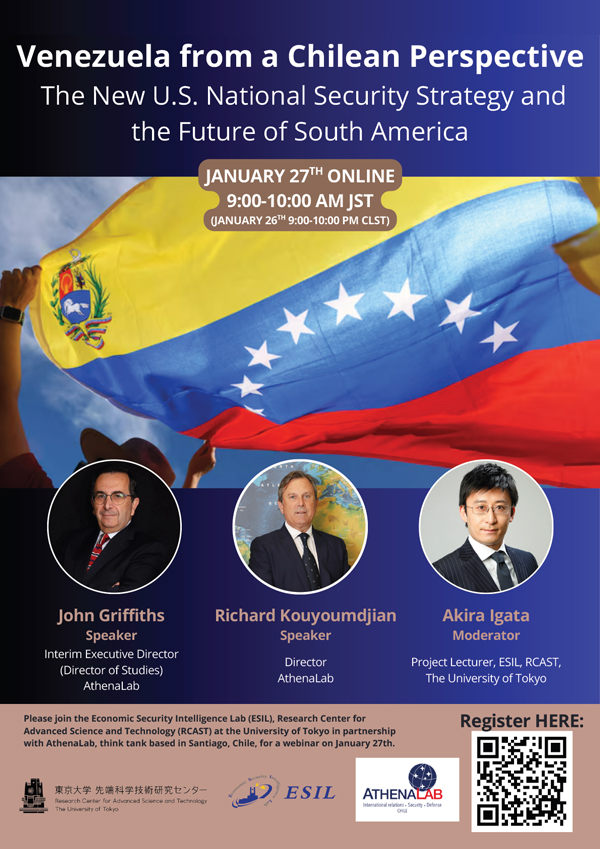
The Economic Security Intelligence Lab (ESIL) at the Research Center for Advanced Science and Technology (RCAST), the University of Tokyo, is pleased to co-host a webinar with the Chilean think tank AthenaLab titled:
Venezuela from a Chilean Perspective:
The New U.S. National Security Strategy and the Future of South America
The situation in Venezuela, which has been tense since the end of last year, began moving rapidly in early January 2026. In the early hours of January 3, the United States conducted a large-scale military operation in Venezuela, detaining President Nicolás Maduro and transporting him out of the country. This move has sent shockwaves through the international community, sparking emergency debates in the UN Security Council and intensifying discussions regarding international law and the principles of sovereignty.
These events are beginning to have a profound impact not only on Venezuela’s internal governance and security but also on the regional order of South America. Reactions among South American nations are divided; several countries, including Brazil and Mexico, have expressed strong concerns regarding unilateral military action.
How is this unprecedented intervention perceived within South America itself? This webinar offers a rare opportunity to engage directly with South American perspectives that are often underrepresented in Japanese and international media coverage.
Chile occupies a unique position: it offers an insider’s perspective as a fellow Latin American nation, yet it also experienced a U.S.-linked regime change in the 1970s before successfully navigating democratization and rebuilding its relationship with the U.S. Today, as a stable middle-power democracy maintaining relations with both the U.S. and China, Chile evaluates the actions of great powers from a measured distance. Drawing on Chile’s historical experience and current standing, this webinar will provide a multi-faceted analysis of what the new U.S. strategy for the Western Hemisphere means for South America and the global order.
We will welcome experts from AthenaLab—a Chilean think tank with which RCAST is planning to sign a Memorandum of Understanding (MOU)—to clarify the volatile situation in Venezuela based on the latest developments. We will specifically focus on the new U.S. National Security Strategy (NSS) released at the end of last year. Under the Trump administration, this strategy explicitly prioritizes the “Western Hemisphere” in its foreign and security policy, and the recent actions in Venezuela must be understood within that context. This seminar will examine how the U.S. is redefining South America as a strategic space, as well as the intentions and implications behind this shift.
Speakers:
John Griffiths is the Director of Studies and Interim Executive Director at AthenaLab. He is a former Army officer. He holds a Bachelor of Military Science, an M.A. in International Security from Georgetown University, and a Doctorate in American Studies with a mention in International Affairs from USACH. He has worked as a teacher at the Pontificia Universidad Católica de Chile, ANEPE, and Adolfo Ibáñez University on issues related to strategic studies, security, and national defense. He has also completed additional studies in these fields at Harvard University, King’s College, and the University of Antwerp (UFSIA).
Richard Kouyoumdjian is the Director of AthenaLab. He has been the General Manager of Indumotora Companies since 2016. His previous professional career includes 20 years in executive positions in Chilean and international banking. Prior to that, he was an officer in the Chilean Navy. He is a Weapons Engineer with a mention in Artillery and Missiles from the Naval Polytechnic Academy. He holds an MBA from the Pontifical Catholic University of Chile and an M.A. in War Studies from King’s College London.
The discussion will be moderated by Akira Igata (RCAST, The University of Tokyo).
This webinar will be conducted in English.