




Researchers including those from the University of Tokyo ran a large survey on issues facing entrepreneurs in Japan. The aim was to build data around the topic of harassment in the entrepreneurial ecosystem. Analysis of survey results suggests that entrepreneurs face harassment from other parties when there is a power asymmetry, in particular when approaching funding. But unlike issues of sexual harassment, general power harassment did not have a gender-based component. A key finding was that the breadth of an entrepreneur's network correlates negatively with received harassment, but more research is needed to determine the nature of this connection.
Those unfamiliar with Japan’s business world might be surprised to hear there’s an abundance of anecdotes and cliches which don’t always paint the local picture in a positive light. There have been some high-profile cases of sexual harassment which even struck a chord with the international media. Harassment in the entrepreneurial ecosystem in particular is known to discourage the growth and foundation of small businesses, and Japan's Ministry of Economy, Trade and Industry is keen to address this for the sake of economic growth. To this end, researchers such as Professor Shintaro Yamaguchi from the University of Tokyo’s Graduate School of Economics and his team have begun to explore entrepreneurial harassment in detail.
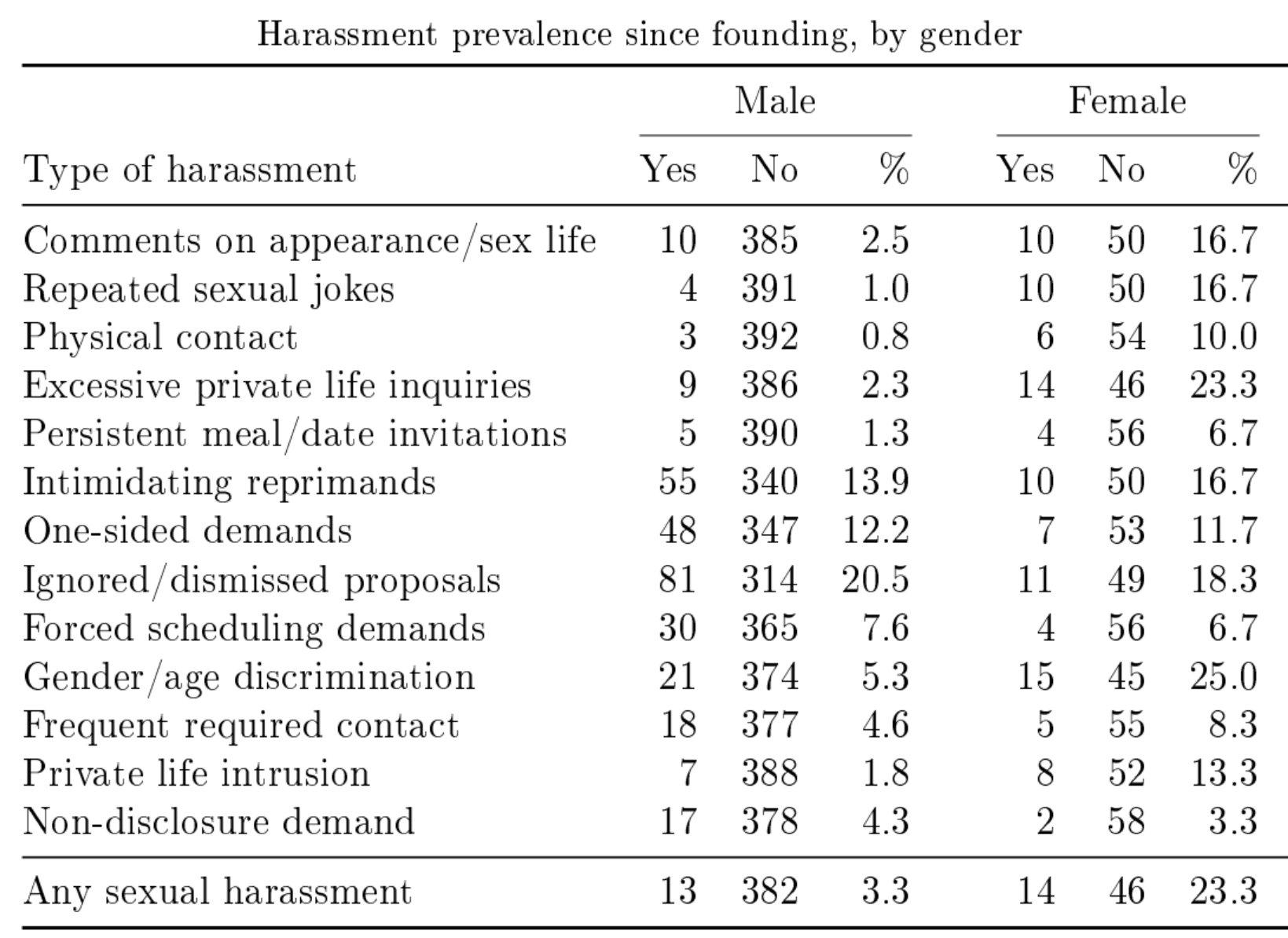
“We surveyed nearly 500 startup founders across Japan and asked them about their experiences with mistreatment from the people they work with, such as investors, business partners, customers and mentors. We found that about 1 in 3 founders had experienced some form of harassment since starting their company. The most common type was not sexual harassment, but what we call nonsexual harassment: things like being bullied, having unreasonable demands imposed on you or being deliberately shut out of discussions by someone who holds more power than you do,” said Yamaguchi. “Sexual harassment was less common overall but affected women at far higher rates than men. We also found that founders who had connections to a wider variety of people in the business world tended to be somewhat less likely to experience sexual harassment. This suggests that having a diverse professional network may help protect entrepreneurs by reducing how dependent they are on any one person.”
The main challenge when carrying out this kind of research is to design surveys that capture honest responses about deeply sensitive topics. Some groups may be more motivated to respond than others, which might bias the outcome. To avoid this, the team designed its survey to be a broad study about conditions in the entrepreneurial ecosystem, covering topics like business operations and professional networks, alongside the harassment questions. They also used behaviorally specific items, asking about concrete experiences rather than whether someone considered themselves a victim, because research shows this approach produces more accurate responses.
“Getting that balance right, asking detailed enough questions to capture real experiences while keeping the overall framing neutral, required a great deal of careful thought,” said Yamaguchi. “Our findings point toward structural solutions rather than just individual awareness. On the investor side, having multiple decision-makers involved in managing a relationship with a founder can reduce the risk that any one person abuses their position. Industry associations and accelerator programs can also establish codes of conduct and create channels for founders to report misconduct without fear of retaliation. More broadly, our data suggest that helping founders build diverse networks, through cross-sector mentoring programs, multistakeholder events and cohort-based accelerators, may reduce vulnerability by ensuring that no single person holds disproportionate influence over a founder’s prospects.”
There are some aspects to this study that the team is keen to explore further. In particular is the direction of causality between network structure and harassment. The data show that founders with broader networks report lower rates of sexual harassment, but a single survey cannot tell whether diverse networks actually protect people or whether people who experience harassment withdraw from networking and end up with narrower networks as a result.
“The startup world runs on asymmetric relationships. Founders need things from other people, whether it is capital from investors, contracts from customers or introductions from mentors, and the people on the other side of those relationships often know they hold the upper hand,” said Yamaguchi. “That kind of power imbalance creates opportunities for many forms of coercion: unreasonable demands, bullying, dismissal of ideas, pressure to comply with inappropriate requests. These behaviors affect anyone in a dependent position, regardless of gender. Sexual harassment, by contrast, tends to follow a more specific pattern tied to gender dynamics. So, while sexual harassment is a real and serious problem, the sheer breadth of power-based mistreatment in entrepreneurial settings means that nonsexual harassment touches far more founders.”