


Title
Meiji Ishin to Kairikugun (The Meiji Restoration and Japan's Naval and Land Forces - From the Early Modern Samurai Polity to the Modern State)
Size
368 pages, A5 format
Language
Japanese
Released
March 26, 2026
ISBN
978-4-13-026355-9
Published by
University of Tokyo Press
Book Info
See Book Availability at Library
Japanese Page
 eBook
eBook
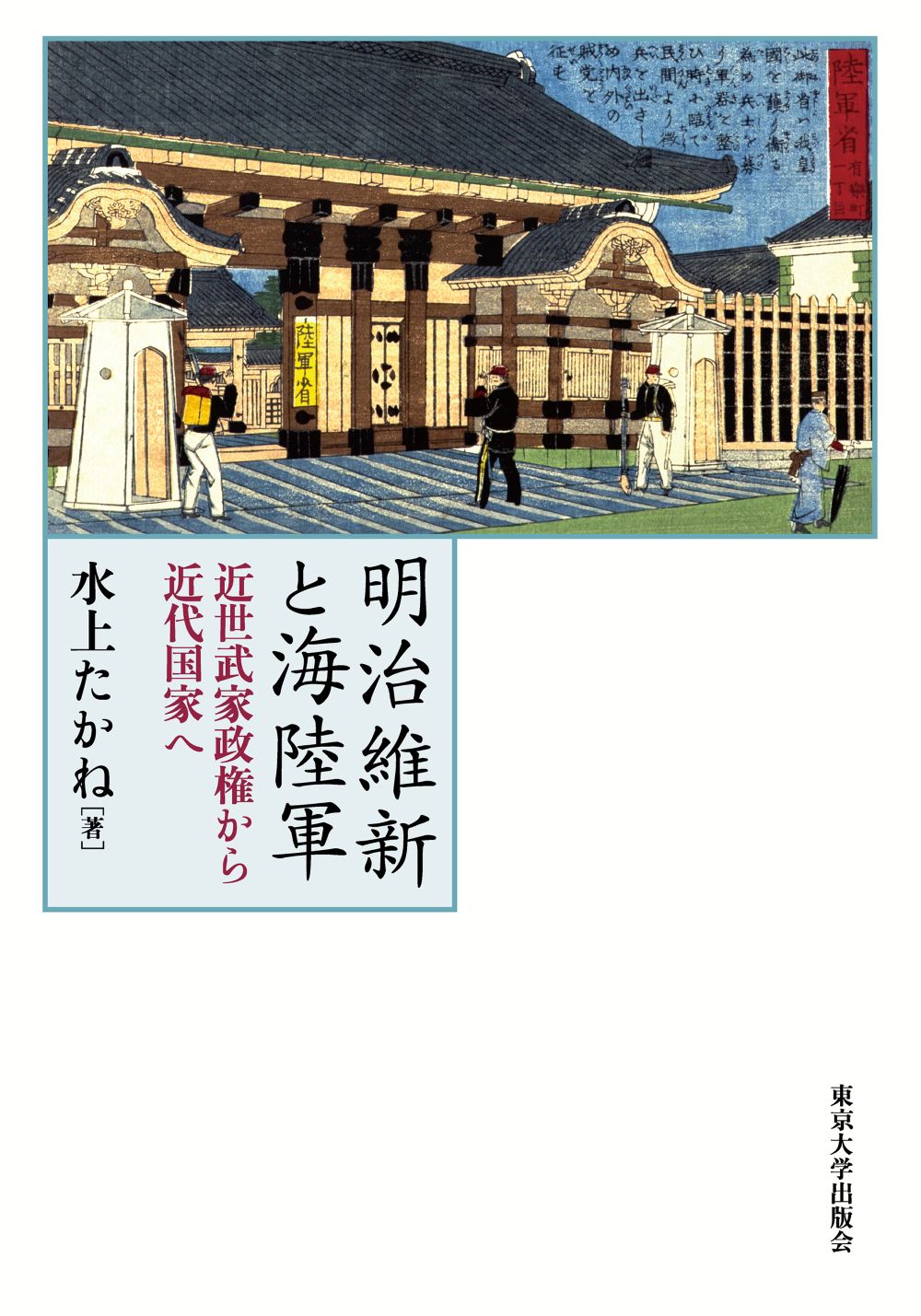
When you pick up this book, the first thing that catches your eye is a nishiki-e (colored woodblock print) from 1876 depicting the Rikugun-shō (Army Ministry). Although it was a government building from the Meiji era, it features a traditional architectural style reminiscent of the Edo period. This is because it occupied the former residence of the Tottori Domain, which had previously served as the headquarters of the Hyōbu-shō (Ministry of the Military), the predecessor of the Rikugun-shō. The Hyōbu-shō and its predecessor, the Gunmu-kan (Ministry of Military Affairs), are the central subjects of this book.
The title is also notable for its use of the term “naval and land forces,” a phrase unfamiliar today. Why not simply use “Army and Navy”? In fact, the army and navy, which in modern Japan are synonymous with the military, did not exist before the late Edo period. The samurai, the ruling class of the Edo period, were essentially warriors, and their system of warfare formed the foundation of the early modern polity. However, after a long period of peace, this system had become obsolete in actual warfare. Faced with foreign pressure and domestic unrest in the late Edo period, the shogunate, the domains, and the Meiji government introduced Western military knowledge, technology, and institutions, making the establishment of “naval and land forces” a top priority. These reforms also led to the dismantling of the samurai’s governing system and social status. The new military system eventually took root in modern Japan as two military branches——the Army and the Navy——as exemplified by the establishment of the Rikugun-shō and Kaigun-shō (Ministry of the Navy) in 1872.
This book focuses on the government offices and agencies responsible for the practical administration of the “naval and land forces” before the establishment of the Rikugun-shō and Kaigun-shō. Through this analysis, it portrays the Meiji Restoration as a transformation from the early modern samurai polity, where military and administrative functions were inseparable, into a modern state in which military administration and military affairs became specialized and institutionally independent within the framework of the Army and the Navy.
By emphasizing the historical term “naval and land forces,” as well as the tendency to prioritize the navy, the book argues that naval construction was indispensable to this transformation. Part One examines the formation of the Tokugawa shogunate’s organization of “naval and land forces” during the Bakumatsu period, focusing primarily on naval institutions. Part Two analyzes the organization and activities of the Meiji government’s Gunmu-kan and Hyōbu-shō during the Meiji Restoration period (1868–1871), especially in relation to the Boshin War, Western-style ships, and the creation of a modern navy.
A key feature of this book is its empirical analysis based on historical sources. Topics such as the personnel system that combined feudal status and meritocracy, logistics during the Second Chōshū Expedition and the Boshin War, military budget issues, and the officials responsible for these matters are highly practical in nature. Because these institutions were still in the process of being formed, they changed frequently and often lacked formal legal codification. This book aims to convey an image of the Bakumatsu and Meiji Restoration periods as revealed through historical sources, preserving, as much as possible, the terminology, complexity, and ambiguity of the time while discussing both continuity and discontinuity in the transition from the Tokugawa shogunate to the Meiji government.
(Written by: MIZUKAMI Takane / October 02, 2026)
Related Info
https://www.u-tokyo.ac.jp/excellent-researchers/member/r1_mizukami.html
Award:
The 6th UTokyo Jiritsu Award for Early Career Academics (The University of Tokyo, 2025)
https://www.u-tokyo.ac.jp/ja/research/systems-data/n03_kankojosei.html