



Charles University, Palacky University Olomouc, KEK and UTokyo Sign MoU to Promote Hyper-Kamiokande Project
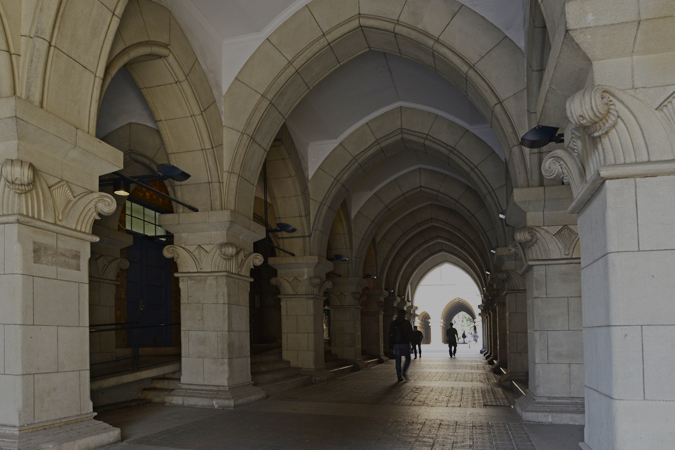
Charles University, Palacky University Olomouc, High Energy Accelerator Research Organization (KEK) and the University of Tokyo (UTokyo) signed a memorandum of understanding (MoU), which aims to promote the Hyper-Kamiokande (HK) international scientific research project, whose main detector has been under construction with plans to start operation in 2028 at Kamioka, Hida City, Gifu Prefecture in Japan. This experiment is an international research project involving twenty-three countries, and Czech is the sixth nation to sign the MoU with Japan, following Poland, Spain, Italy, Canada and France.
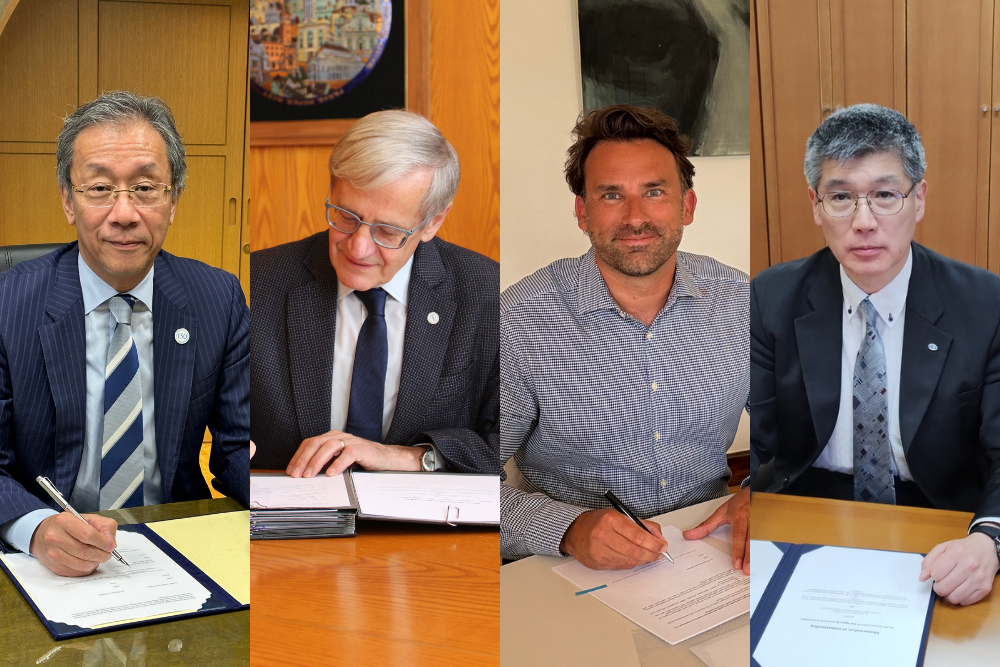
UTokyo President Teruo Fujii(left), Charles University Rector Jiří Zima (center left), Palacky University Olomouc Rector Michael Kohajda (center right) and KEK Director General Shoji Asai(right) signing the MoU ©UTokyo, Charles University, Palacky University Olomouc, KEK
UTokyo President Teruo Fujii, KEK Director General Shoji Asai, Charles University Rector Jiří Zima and Palacky University Olomouc Rector Michael Kohajda exchanged signatures by post by late July of 2026.
According to the MoU, the Czech participation in Hyper-Kamiokande has been organized by two groups: Charles University and Palacky University Olomouc. The major expected contributions of Czech are tests of 3" PMTs for the multi-PMT modules, optical soak tests of multi-PMT's construction materials, and development, testing, production, and installation of the far-detector multi-PMT concentration card vessels.
The Hyper-Kamiokande detector is planned to have a fiducial mass eight times larger than its predecessor detector, Super-Kamiokande, and it is equipped with newly developed high-sensitivity photosensors. The aim of the project is to elucidate the Grand Unified Theory and the history of the evolution of the Universe through an investigation of proton decay and CP violation (the asymmetry between neutrinos and antineutrinos), together with the observation of neutrinos from supernova explosions. The budget of the construction was approved by the Japanese Diet, which marked the official start of the project in February 2020. Construction has gotten into full swing with the main cavern excavation which started in November 2022 and successful completion of the main cavern excavation in July 2025.
UTokyo President Teruo Fujii, KEK Director General Shoji Asai, Charles University Rector Jiří Zima and Palacky University Olomouc Rector Michael Kohajda exchanged signatures by post by late July of 2026.
According to the MoU, the Czech participation in Hyper-Kamiokande has been organized by two groups: Charles University and Palacky University Olomouc. The major expected contributions of Czech are tests of 3" PMTs for the multi-PMT modules, optical soak tests of multi-PMT's construction materials, and development, testing, production, and installation of the far-detector multi-PMT concentration card vessels.
The Hyper-Kamiokande detector is planned to have a fiducial mass eight times larger than its predecessor detector, Super-Kamiokande, and it is equipped with newly developed high-sensitivity photosensors. The aim of the project is to elucidate the Grand Unified Theory and the history of the evolution of the Universe through an investigation of proton decay and CP violation (the asymmetry between neutrinos and antineutrinos), together with the observation of neutrinos from supernova explosions. The budget of the construction was approved by the Japanese Diet, which marked the official start of the project in February 2020. Construction has gotten into full swing with the main cavern excavation which started in November 2022 and successful completion of the main cavern excavation in July 2025.