



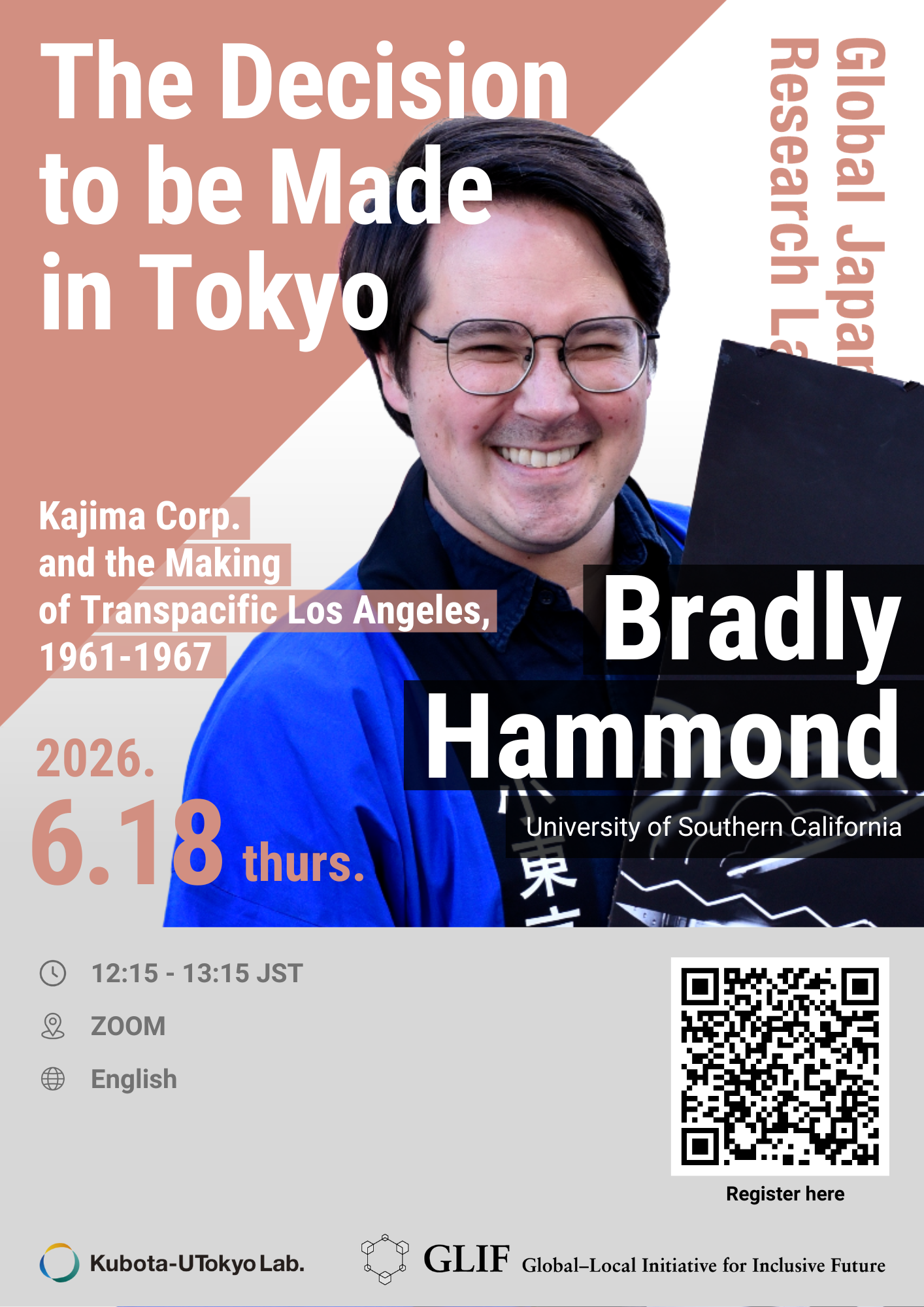
“The Decision to be Made in Tokyo”: Kajima Corporation and the Making of Transpacific Los Angeles, 1961-1967
Details
| Type | Lecture |
|---|---|
| Intended for | General public / Enrolled students / Applying students / International students / Alumni / Companies / Elementary school students / Junior high school students / High school students / Technical college students / University students / Academic and Administrative Staff |
| Date(s) | June 18, 2026 12:15 — 13:15 |
| Location | Online |
| Venue | Online (Zoom Webinar) |
| Entrance Fee | No charge |
| Registration Method | Advance registration required
Please register via the webpage below: https://glif.ga.a.u-tokyo.ac.jp/en/events/671/ |
| Registration Period | June 3, 2026 — June 18, 2026 |
| Contact | Mail: contact-group@g.ecc.u-tokyo.ac.jp |
This talk explores the global context and local impacts of Japanese corporate entry into the United States through a case study of the Kajima Corporation’s venture into Los Angeles, California in the early 1960s. Why did one of Japan’s largest construction companies establish its first post-1945 overseas branch in Los Angeles’s Little Tokyo? How did Japanese American Angelenos shape Kajima’s business trajectory in Little Tokyo?
Drawing on a bilingual and transnational sourcebase as well as the theories of Takashi Fujitani and Meredith Oda, this talk argues that Kajima’s leadership consciously merged its post-Occupation aspirations for improved status in a U.S.-led liberal global order with Japanese American elites’ post-WWII aspirations for privileged status in the U.S. domestic order–and, vice versa. In this way the 1967 Kajima Building, the first structure ever built on U.S. soil by a Japanese construction company, can be understood as the product of a transpacific compact between Japanese and Japanese American elites. Studying the Kajima Corporation’s foray into 1960s Los Angeles thus helps deepen our understanding of U.S.-Japan diplomatic history, U.S. ethnic history, and U.S. urban history in the early Cold War era.
Drawing on a bilingual and transnational sourcebase as well as the theories of Takashi Fujitani and Meredith Oda, this talk argues that Kajima’s leadership consciously merged its post-Occupation aspirations for improved status in a U.S.-led liberal global order with Japanese American elites’ post-WWII aspirations for privileged status in the U.S. domestic order–and, vice versa. In this way the 1967 Kajima Building, the first structure ever built on U.S. soil by a Japanese construction company, can be understood as the product of a transpacific compact between Japanese and Japanese American elites. Studying the Kajima Corporation’s foray into 1960s Los Angeles thus helps deepen our understanding of U.S.-Japan diplomatic history, U.S. ethnic history, and U.S. urban history in the early Cold War era.